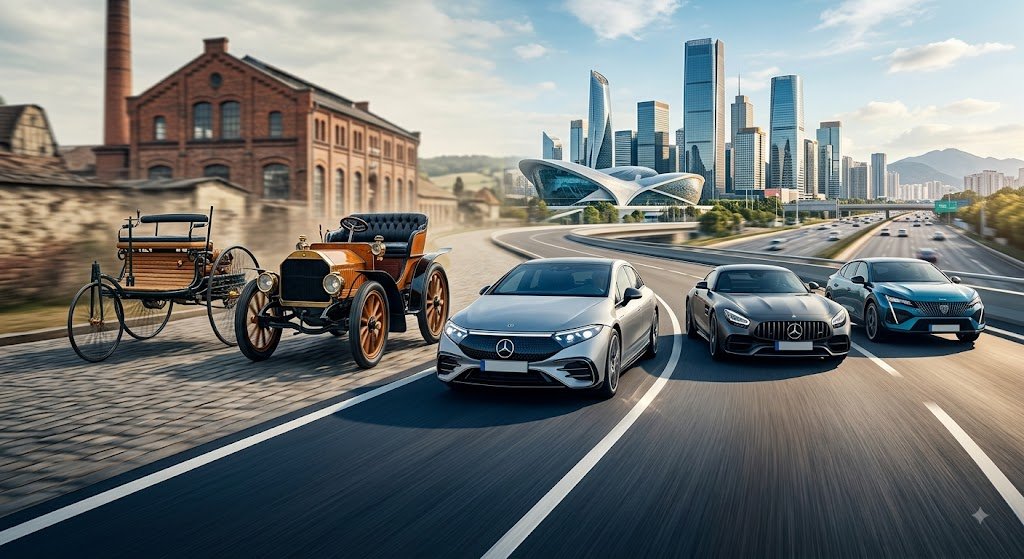
When Karl Benz patented his historic Motorwagen in 1886 and Gottlieb Daimler fitted an engine into a customized horse carriage shortly after, few onlookers could have predicted the revolution they were starting. Those noisy, rattling contraptions were widely viewed as noisy playthings for the wealthy. Over thirteen decades later, those humble pioneer workshops have evolved into colossal global empires that shape how billions of people move every single day.
While thousands of ambitious automotive startups have spun their wheels, declared bankruptcy, and vanished into forgotten archives over the past century, a select group of legendary pioneer automakers has defied all odds. Brands like Mercedes-Benz, Peugeot, Škoda, Renault, and Fiat are not merely surviving on fond historical nostalgia. Instead, they are actively sitting in the driver’s seat of today’s hyper-competitive global car market.
It is one of the most remarkable paradoxes in modern industrial history. Companies that originally started by forging steel blades, manufacturing sewing machines, assembling bicycles, or building textile equipment are now designing artificial-intelligence-powered electric vehicles. More than 130 years after laying the groundwork for personal transportation, these veteran car manufacturers continue to build and roll out ambitious new models month after month.
How exactly do you keep a brand feeling fresh, youthful, and exciting when your corporate registry dates back to the Victorian era? For these long-standing automakers, the secret recipe lies in striking a delicate balance between honoring tradition and pursuing radical innovation. They treat their rich heritage not as a heavy anchor holding them back, but as a spring-loaded launching pad for future technology.
Take Mercedes-Benz, widely recognized as the direct descendant of the company that literally invented the petrol-powered automobile. Today, the German luxury manufacturer continues to push the boundaries of luxury and performance with futuristic zero-emission sedans, high-tech SUVs, and self-driving software. Yet, if you look closely, a subtle thread of exquisite craftsmanship connects their latest battery-powered concepts directly to those brass-trimmed trikes of the late 1800s.
Across the border in France, Peugeot holds the proud title of the world’s oldest surviving automotive brand in continuous corporate existence, having originally registered as a family steel mill way back in 1810 before debuting its first vehicle in 1889. Fast forward to today’s showroom floors, and the French lion brand is turning heads across Europe with razor-sharp, ultra-modern electric fastbacks that look as though they rolled straight off a Hollywood science-fiction film set.
Meanwhile, Czech automotive giant Škoda, which famously began as a modest bicycle repair shop founded by Vaclav Laurin and Vaclav Klement in 1895, has reinvented its identity multiple times across three separate centuries. Today, as part of a modern manufacturing network, it produces some of the most practical, spacious, and clever electric SUVs on the market, proving that enduring longevity comes from truly understanding everyday drivers.
Italian powerhouse Fiat also joined the party before the turn of the 20th century, opening its doors in 1899. From crafting early luxury touring cars to personal mobility icons like the original Topolino and 500, Fiat helped put an entire nation on wheels. Today, the brand continues its vibrant legacy by transforming its beloved classic shapes into quirky, urban electric vehicles tailored specifically for modern city dwellers.
What makes these original vehicle builders so astonishingly resilient is their proven ability to navigate monumental historical disruptions. Over the last 130 years, they survived two catastrophic World Wars, dramatic economic depressions, shifting political borders, severe resource shortages, and endless changes in public taste. Having successfully weathered a century of global upheavals, transitioning to battery power and autonomous driving feels like just another day at the office.
In fact, industry analysts note that today’s electric vehicle revolution bears a striking resemblance to the wild, creative atmosphere of the late 19th century. Back when the automobile was in its infancy, ambitious inventors were fiercely debating whether steam power, battery electricity, or internal combustion would dominate the roadways. More than 130 years later, these veteran manufacturers find themeselves right back in that familiar arena, once again reinventing the wheel.
There is also a powerful psychological advantage that heritage automakers hold over modern competition in an increasingly crowded global landscape. While shiny new electric vehicle startups arrive with grand promises, massive marketing budgets, and sleek touchscreens, they often lack deep emotional roots. Generations of families have grown up riding in, learning to drive with, and trusting these historic badges, creating an irreplaceable bond of trust.
To remain at the top of their game, however, these historic factories have undergone staggering digital transformations. Modern assembly lines at these legacy facilities feature collaborative robotic arms, automated quality control sensors, 3D printing labs, and zero-waste sustainability practices. The greasy, coal-dusted workshops of the Victorian era have evolved into ultra-clean, quiet technology hubs that produce thousands of high-tech vehicles daily.
As the automotive industry accelerates toward an electrified and fully connected future, these pioneer companies demonstrate that longevity is far from a disadvantage. They prove that true industrial mastery is not about abandoning your past, but continuously evolving it to meet the desires of new generations. More than 130 years after making history, the world’s earliest carmakers are nowhere near finished writing their story.