
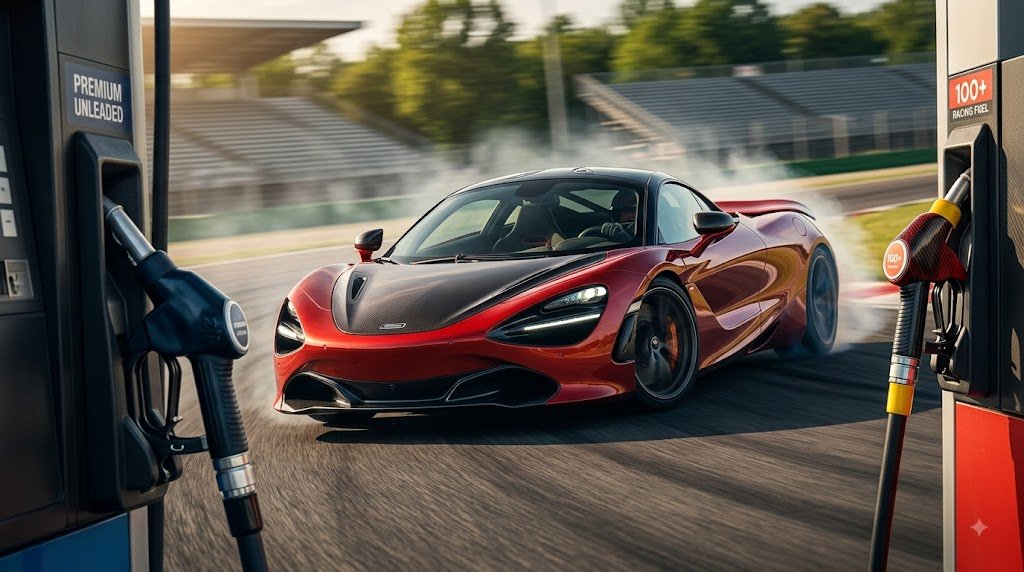
Every automotive enthusiast knows the intoxicating allure of pulling up to the gas pump in a high-performance sports car. You pull in, stare at the glowing numbers on the fuel selection buttons, and ponder the classic driver’s dilemma. Will standard premium gasoline unleash your engine’s true potential, or should you hunt down high-octane racing fuel for extra horsepower?
It is a lively debate that rages across garage floors, internet forums, and weekend track days alike. Drivers regularly whisper rumors about dramatic speed gains, engine preservation, and buttery-smooth acceleration. But when we strip away the myth and look at actual engine combustion efficiency, which fuel truly reigns supreme for modern sports cars?
To understand this high-octane showdown, one must first dismantle a widespread myth floating around driver circles. Octane rating is not a direct measurement of the raw thermal energy stuffed into a gallon of fuel. Instead, an octane number reflects a fuel’s ability to resist pre-ignition, commonly known as dangerous engine knocking or detonation.
When high-performance sports cars compress air and fuel inside their cylinders, immense heat and pressure build up rapidly. Premium pump gasoline, typically rated between 91 and 94 octane, is engineered specifically to prevent uncontrolled explosions before the spark plug fires. It allows modern high-compression engines to burn fuel cleanly and predictably under heavy road acceleration.
On the other hand, specialized racing fuel boasts octane numbers ranging anywhere from 100 to well over 115. These extreme blends are crafted to withstand tremendous cylinder pressures found in purpose-built racecraft and heavily modified forced-induction engines. They act as a massive safety shield against catastrophic engine knock, allowing race mechanics to push turbochargers and timing curves to their absolute limits.
However, throwing 100-octane racing fuel into a factory-spec sports car tuned for 93 octane does not magically create extra power. If an engine cannot increase its compression ratio, advance its ignition timing, or boost turbo pressure to take advantage of that higher detonation resistance, the excess octane simply goes unused. In fact, running ultra-high octane without proper tuning can actually decrease combustion efficiency.
Efficiency in a sports car is ultimately measured by thermal efficiency—how effectively an engine converts chemical fuel energy into raw kinetic motion. Premium pump gas is formulated with sophisticated detergent additives and precise volatility profiles tailored for street driving, ambient thermal swings, and stop-and-go commuting. It ignites reliably, burns thoroughly, and maximizes fuel economy for everyday performance vehicles.
Racing fuel, conversely, is formulated for a hyper-specific mission on the track. Many racing blends contain high oxygen content or specialized chemical compounds like ethanol and toluene that alter the burn rate. When paired with an engine explicitly calibrated for it, race fuel allows aggressive ignition timing that extracts maximum mechanical work from every single combustion cycle.
When evaluated strictly through the lens of power output per dollar spent on a stock vehicle, premium pump gas takes the victory crown every time. Modern Engine Control Units (ECUs) are brilliant computer brains capable of adjusting timing on the fly. Running premium fuel enables these systems to run at their peak factory power band without wasting money or risking unburnt fuel deposits.
Where racing fuel truly shines in terms of efficiency is under extreme thermal stress. Picture a high-horsepower track monster doing hot laps in the blazing summer heat. Under sustained wide-open throttle, intake temperatures skyrocket, and cylinder walls heat up significantly. In this intense environment, premium pump fuel might force the ECU to pull back timing to prevent engine knock.
By switching to high-octane racing fuel for track sessions, drivers eliminate heat-induced knock altogether. The engine can maintain its maximum timing advance, preventing thermal throttling and ensuring consistent horsepower lap after lap. In this specific high-stress environment, racing fuel provides volumetric efficiency and mechanical reliability that standard premium fuel simply cannot match.
Yet, drivers must proceed with caution before pouring track fuel into their street machines. Many high-octane race fuels still contain lead additives or heavy oxygenates that will instantly ruin modern catalytic converters and oxygen sensors. Unless you are running an off-road dedicated race vehicle, unoxygenated unleaded racing gas is the only safe option for modern street emissions equipment.
So, which liquid power source takes the ultimate trophy for powering sports cars efficiently? For everyday driving, canyon carving, and occasional spirited highway cruises, premium pump gasoline is unquestionably the superior choice. It delivers optimal power, tailored detergent protection, and peak fuel efficiency without inflating your wallet at the pump.
Racing fuel is a high-tech tool designed for specialized performance environments, custom ECU tunes, and extreme track heat. It isn’t a magical elixir that turns street cars into supercars, but rather a high-octane shield that enables heavily modified engines to operate safely at their absolute limits. Understanding your car’s specific engine calibration is the true secret to unlocking its maximum energy potential!