
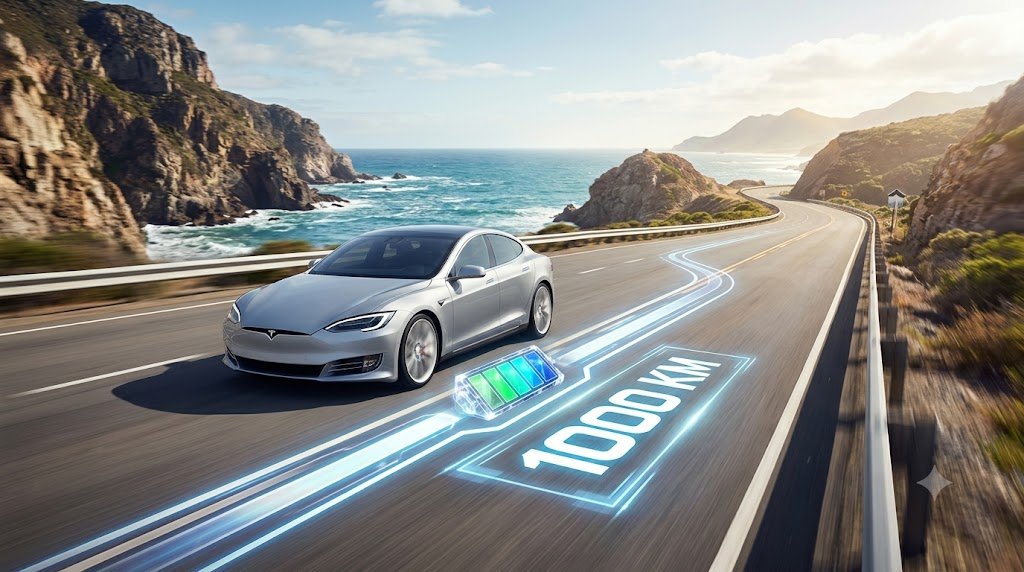
For years, the biggest speed bump stopping millions of drivers from swapping gas pumps for charging plugs has been a pesky phenomenon known as range anxiety. The mental math of calculating distance between chargers on long highway road trips has given even the most eco-conscious commuters a headache.
That familiar highway stress is about to become a distant memory thanks to a quiet revolution brewing inside automotive research labs. Next-generation solid-state and advanced semi-solid battery technologies are officially stepping out of experimental facilities and rolling onto real-world roads, bringing a whopping 1,000-kilometer (620-mile) range capability on a single charge.
Imagine embarking on a cross-country journey from London to Berlin, or Sydney to Melbourne, without stopping once for power. This landmark shift promises to reshape green transportation forever.
What Makes Solid-State Batteries a Complete Game-Changer?
Traditional lithium-ion batteries that power today’s standard electric cars rely on liquid or gel electrolytes to move energy back and forth. While reliable, liquid systems suffer from inherent limitations in energy density, vulnerability to freezing temperatures, and flammable organic solvents that demand heavy cooling systems.
Solid-state technology completely ditches the liquid chemical soup in favor of solid ceramic, polymer, or sulfide-based electrolytes. By removing liquid layers, engineers can pack far more energy into a significantly smaller, lighter footprint—effectively doubling or tripling the battery pack’s overall energy density.
Current premium EV battery packs deliver between 150 to 250 Watt-hours per kilogram (Wh/kg). Breakthrough solid-state designs regularly hit 350 to 500 Wh/kg, unlocking massive mileage gains without turning vehicles into heavy land yachts.
Lightning-Fast Charging and Ironclad Safety
It is not just about going further on a single charge; it is also about how fast you can hit the road again once your battery runs low. Because solid electrolytes tolerate higher voltages and thermal strain far better than liquid equivalents, charge times drop dramatically.
Next-generation cell architectures allow drivers to juice up from 10% to 80% capacity in 10 minutes or less. That is roughly the same amount of time it takes to grab a cup of coffee and use the rest stop restroom before hitting the highway again.
Safety receives a massive upgrade as well, as solid materials eliminate the risk of flammable liquid leaks or runaway fires caused by thermal stress. Additionally, these cells maintain up to 70% to 80% of their performance in freezing winter conditions as cold as -30°C (-22°F), solving another major EV headache.
From Concept Cars to Commercial Reality: Who Is Leading the Race?
Automotive giants and specialized battery makers around the globe are locked in a high-stakes sprint to bring 1,000 KM EV batteries into commercial showrooms. While full solid-state manufacturing scaling continues to mature, “semi-solid” bridge technologies have already debuted in commercial road models.
Innovative Chinese automakers like NIO and IM Motors have showcased semi-solid 150 kWh battery packs achieving over 1,000 kilometers of range under real-world testing conditions. Meanwhile, Chery recently unveiled solid-state battery models like the Exeed series targeting 1,000 KM to 1,500 KM driving ranges.
Legacy powerhouses are not standing idle either; Toyota, BYD, Mercedes-Benz, and CATL have outlined aggressive production roadmaps. Toyota targets commercial rollouts of solid-state EVs offering 1,000 KM range and sub-10-minute fast charging, signaling a massive seismic shift in global automotive manufacturing.
The Road Ahead: Challenges on the Way to Mass Adoption
While the technical achievements are undeniably breathtaking, a few speed bumps remain before every suburban driveway parks a 1,000 KM solid-state EV. Manufacturing solid-state cells requires pristine cleanroom environments, microscopic interface precision, and specialized material supply chains.
Consequently, initial production runs are landing first in flagship luxury models and specialized performance fleets before trickling down to mass-market economy hatchbacks. Industry analysts project that as production yields scale up, manufacturing costs will drop, making super-range EVs accessible to everyday commuters.
Nevertheless, the era of compromising on range, shivering in cold weather, or spending hours plugged into slow public chargers is officially coming to a close. The future of clean, unlimited highway cruising has arrived, and it is powered by solid-state innovation.
Frequently Asked Questions (FAQ)
What is the main difference between a traditional EV battery and a solid-state battery?
Traditional EV batteries use a flammable liquid electrolyte to transport electrical charges between internal electrodes. Solid-state batteries replace this liquid with a solid ceramic, glass, or polymer material, making the battery significantly safer, lighter, and far more energy-dense.
How does a 1,000 KM battery affect the overall weight of an electric car?
Because solid-state chemistry offers significantly higher energy density (up to 500 Wh/kg compared to 200 Wh/kg in standard lithium-ion), manufacturers can store twice as much power in a pack of similar or lighter physical weight. This prevents the car from becoming overly heavy.
When will electric cars with 1,000 KM solid-state batteries be widely available?
Semi-solid state vehicles offering 1,000 KM range are already entering select markets in limited numbers. Full mass-market commercial adoption across major global automakers like Toyota, BYD, and Mercedes-Benz is scaling rapidly between now and the end of the decade.
Will solid-state batteries cost more than existing EV batteries?
Initially, yes. Due to early-stage manufacturing processes and specialized materials, solid-state batteries will carry a premium price tag on high-end luxury vehicles. However, as gigafactories expand production lines and simplify assembly, prices are expected to drop below current lithium-ion costs over time.