
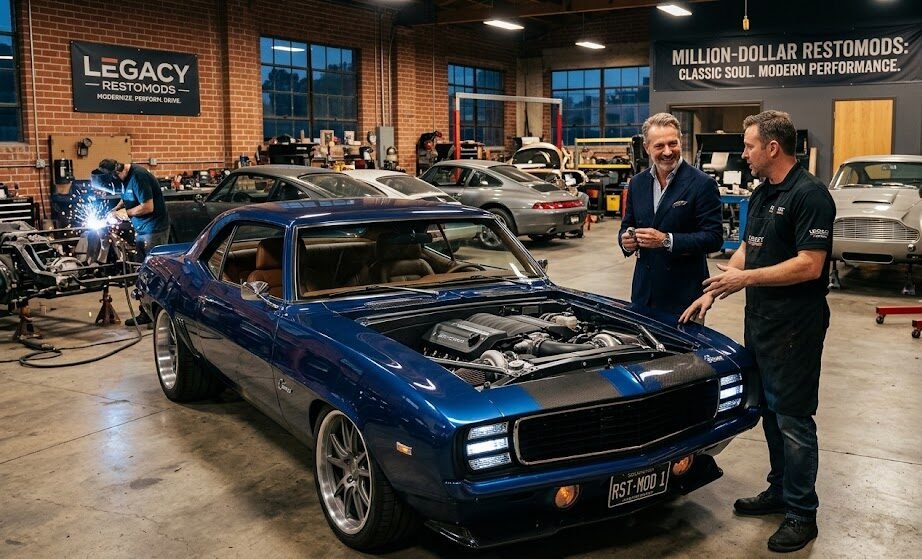
The first time I saw a properly built restomod in person, I honestly had to look twice. From a distance, it looked like a beautifully preserved classic car, the kind of machine that belonged behind velvet ropes at a prestigious concours event. But once the engine started and the car moved, the illusion disappeared. The classic body remained, but underneath was something completely different—a modern performance machine wearing a vintage suit.
That experience helped me understand why million-dollar restomods are becoming increasingly attractive to wealthy collectors. These cars are not simply restored classics, and they are certainly not ordinary modified vehicles. They are carefully engineered hybrids that combine the emotional appeal of automotive history with the speed, reliability, comfort, and technology of a modern supercar.
In 2026, the restomod movement has reached a fascinating point. Wealthy collectors are increasingly willing to spend extraordinary amounts of money transforming iconic classics into bespoke machines that can be driven regularly rather than simply admired in a garage.
What Exactly Is a Restomod?
The word “restomod” combines restoration and modification.
A traditional restoration attempts to return a classic car to its original factory specification. A restomod takes a different approach. The vehicle retains its historical character and recognizable design, but modern components are introduced to improve performance, safety, reliability, and usability.
Depending on the builder and budget, a restomod might feature:
- A modern high-performance engine
- Upgraded suspension
- Carbon-fiber body components
- Modern braking systems
- Advanced infotainment
- Custom air conditioning
- Electric power steering
- High-performance transmissions
- Modern safety technology
- Bespoke handcrafted interiors
The result is a vehicle that can look 50 years old while driving like something created this decade.
And that contradiction is precisely what makes the category so exciting.
Why Wealthy Collectors Are Spending Millions
For ultra-high-net-worth collectors, buying another factory-built supercar is relatively easy.
The market already offers plenty of choices.
There are limited-production hypercars, exotic grand tourers, and track-focused machines capable of extraordinary performance. But these cars share one problem: someone else designed them.
A million-dollar restomod offers something different.
It provides personalization.
The owner can choose the engine character, suspension setup, interior materials, paint color, wheel design, and technological features. In some cases, the collector is effectively commissioning a rolling piece of automotive art.
This creates an emotional connection that mass-produced luxury vehicles struggle to replicate.
The New Luxury Is Uniqueness
Luxury has changed dramatically.
A decade ago, owning an expensive car often meant owning the newest and most exclusive model available. Today, wealthy collectors increasingly value individuality.
The question is no longer simply:
“How expensive is your car?”
Instead, the more interesting question is:
“Who built it, and what makes yours different?”
This shift has created opportunities for specialist restomod companies that can produce extremely limited vehicles.
A builder might create only a handful of cars each year. Each vehicle can involve thousands of hours of engineering, fabrication, machining, leatherwork, and testing.
The limited production itself becomes part of the value proposition.
A Case Study in the Restomod Mindset
Imagine a collector purchasing a classic 1960s performance car.
The original vehicle may have a beautiful design but outdated brakes, unreliable electronics, a rough ride, and limited performance by modern standards.
Instead of preserving it exactly as it left the factory, the owner commissions a comprehensive restomod.
The original chassis is carefully inspected and reinforced.
A modern performance engine is installed.
The suspension is redesigned.
Brakes are upgraded.
The interior receives handcrafted leather and modern climate control.
A discreet infotainment system provides navigation and connectivity without destroying the vintage appearance.
The finished car may cost more than a brand-new supercar.
Yet the owner receives something a new supercar cannot provide: history.
The vehicle carries decades of automotive identity while offering modern usability.
That combination is incredibly powerful.
The Numbers Behind the Opportunity
The broader collector-car market has demonstrated that rare, historically significant vehicles can command extraordinary prices.
Classic cars from iconic brands have achieved multi-million-dollar valuations at major auctions, while specialized builders have demonstrated that high-end modifications can also attract wealthy buyers.
The restomod market occupies an interesting position between these worlds.
It borrows the emotional value of classic cars and the performance expectations of modern vehicles.
| Restomod Opportunity | Collector Appeal | Growth Potential |
|---|---|---|
| Classic Porsche restomods | Heritage + performance | Very High |
| Vintage American muscle | Raw character + modern power | High |
| Classic European GT cars | Luxury + exclusivity | Very High |
| Japanese performance classics | Rising cultural value | High |
| Electric classic conversions | Sustainability + innovation | Emerging |
| One-off coachbuilt projects | Ultimate personalization | Very High |
The biggest opportunity may not necessarily be in the most expensive cars.
As younger collectors enter the market, interest in 1980s and 1990s performance vehicles is increasing. Cars once considered ordinary used vehicles are now becoming cultural icons.
This could create an entirely new generation of restomod projects.
The Rise of the Japanese Restomod
One of the most interesting developments is the growing interest in Japanese classics.
For years, European and American vehicles dominated the collector-car conversation.
But models from Japanese manufacturers are increasingly attracting attention.
Cars associated with legendary performance eras are particularly interesting to younger collectors. Their cultural presence in motorsport, video games, movies, and enthusiast communities has created powerful emotional connections.
A carefully restored and upgraded Japanese performance car can offer something different from a traditional European classic.
It represents a different kind of automotive nostalgia.
And nostalgia is becoming increasingly valuable.
Technology Is Quietly Changing the Restomod Industry
Modern restomods are becoming increasingly sophisticated.
Computer-aided design allows builders to develop components with incredible precision.
3D scanning can capture the exact dimensions of a vintage vehicle.
Modern manufacturing techniques allow custom parts to be produced in small quantities.
Advanced materials such as carbon fiber can reduce weight while improving structural performance.
Even artificial intelligence could eventually influence the industry by helping designers optimize aerodynamics, simulate vehicle dynamics, or develop more efficient manufacturing processes.
The result is an industry where old-school craftsmanship and modern engineering increasingly work together.
That combination may become the defining characteristic of the next generation of collector cars.
My Perspective: Restomods Are Automotive Time Machines
The most fascinating thing about restomods is that they challenge the traditional definition of restoration.
Should a classic car be preserved exactly as it was?
Or should it evolve?
There is no universal answer.
For museums, originality may be essential.
For collectors who actually drive their cars, modernization can make perfect sense.
A restomod allows an owner to experience the design language of the past without accepting all of its mechanical limitations.
It is almost like traveling through time, but bringing modern technology with you.
You get the visual drama of yesterday and the driving experience of today.
Why Million-Dollar Restomods Could Become Even More Valuable
The restomod industry benefits from several long-term trends.
First, the supply of truly iconic classic cars is limited.
Second, wealthy collectors increasingly want personalized vehicles.
Third, modern technology makes it possible to improve classic platforms dramatically.
Finally, younger generations are developing their own definitions of automotive heritage.
This could make restomods particularly interesting as cultural artifacts.
The challenge, however, is authenticity.
A poorly executed modification can destroy the character of a classic vehicle.
A truly exceptional restomod does the opposite.
It respects the original design while improving everything underneath.
That is where craftsmanship becomes more important than money.
The Business Opportunity for Specialist Builders
The growth of million-dollar restomods is creating opportunities beyond vehicle sales.
Specialist businesses can generate revenue through:
- Custom engineering
- Carbon-fiber manufacturing
- Bespoke interiors
- Performance tuning
- Classic car sourcing
- Restoration consulting
- Vehicle storage
- Collector events
- Maintenance services
- Digital vehicle documentation
For entrepreneurs with expertise in automotive engineering and luxury craftsmanship, this is an increasingly attractive niche.
The biggest opportunity may belong to companies that can combine engineering excellence with storytelling.
Because wealthy collectors are not simply buying transportation.
They are buying identity.
What Buyers Should Know Before Commissioning a Restomod
A million-dollar restomod is not an impulse purchase.
Collectors should carefully evaluate the builder’s reputation, engineering expertise, project history, and after-sales support.
The quality of the underlying vehicle is also critical.
Documentation matters.
Originality matters.
Provenance matters.
So does the ability to maintain the vehicle decades into the future.
Collectors should also understand that not every expensive restomod will automatically become a valuable investment.
Some will become highly desirable collector pieces.
Others may simply represent expensive personal projects.
The smartest approach is to buy a car because you genuinely love it first.
Potential appreciation should be considered a bonus rather than the primary reason for ownership.
The Future of Million-Dollar Restomods
The rise of million-dollar restomods represents something bigger than a trend in the luxury automotive market.
It reflects a cultural shift in how wealthy collectors define exclusivity.
The future may belong to vehicles that combine heritage, technology, craftsmanship, and individuality.
Classic cars will continue to attract collectors because their stories cannot be replicated.
Modern supercars will continue pushing the limits of performance.
But restomods occupy the space between these two worlds.
They offer the best parts of both.
As technology becomes more sophisticated and collectors become more interested in personalization, the restomod industry could evolve into one of the most exciting corners of the luxury automotive market.
The ultimate status symbol may no longer be the newest hypercar sitting in a showroom.
It could be a 60-year-old classic that has been completely reimagined, engineered to perfection, and built specifically for one person.
And perhaps that is the real appeal of the million-dollar restomod.
It doesn’t just preserve the past.
It gives the past a second life—and makes it faster.
Frequently Asked Questions
What is a million-dollar restomod?
A million-dollar restomod is a highly customized classic vehicle that has undergone extensive restoration and modernization. The project may include a modern powertrain, advanced suspension, upgraded brakes, custom interiors, and bespoke engineering.
Why are wealthy collectors interested in restomods?
Collectors are attracted to the combination of classic design, modern performance, exclusivity, and personalization. A restomod can be built specifically around the owner’s preferences.
Are restomods good investments?
Some restomods may appreciate in value, particularly those created by respected builders using historically significant vehicles. However, there is no guarantee of financial returns, so collectors should prioritize craftsmanship and personal enjoyment.
Are restomods better than original classic cars?
It depends on the collector. Purists often prefer original vehicles, while drivers may appreciate the reliability and performance advantages of a restomod.
Which classic cars are popular for restomod projects?
Popular candidates include classic Porsche models, American muscle cars, European grand tourers, and increasingly Japanese performance vehicles from the 1980s and 1990s.
Could electric powertrains become popular in restomods?
Yes. Electric conversions are already attracting attention because they can deliver instant torque, reduced maintenance, and modern drivability while preserving the visual character of classic vehicles.