
When you watch a rider lean into a hairpin turn at 60 degrees, skim their knees along the tarmac, and launch onto a straightaway at over 350 kilometers per hour, it is easy to assume you are looking at a heavily modified version of a showroom motorcycle. That assumption, however, could not be further from the truth.
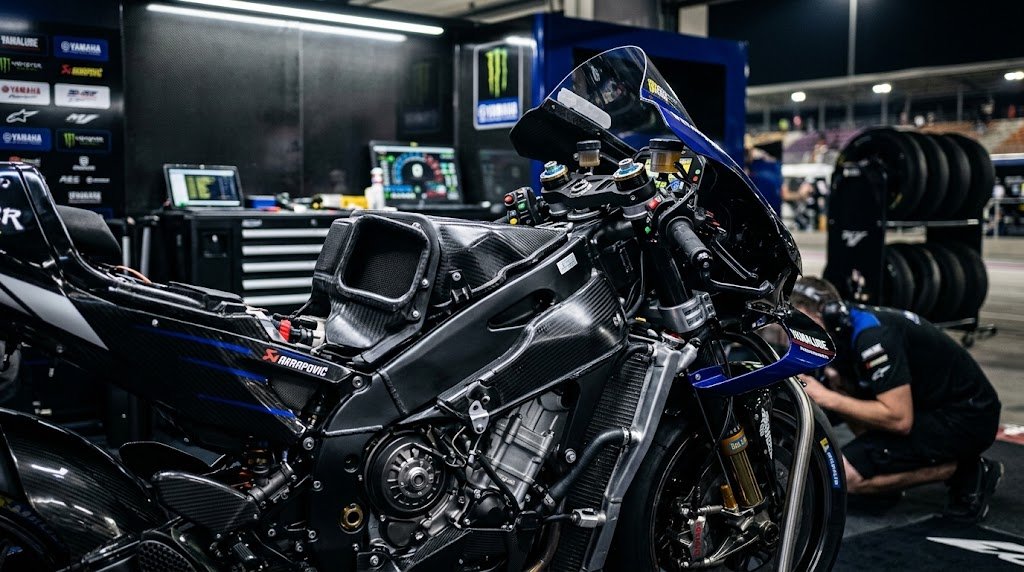
The machines roaring around Grand Prix circuits worldwide are not off-the-shelf superbikes with upgraded exhaust systems. They are purpose-built, one-of-a-kind prototypes designed solely to chase fractions of a millisecond. Every single component is forged from exotic materials, crafted by top-tier aerospace engineers, and tuned to the absolute limit of modern physics.
To understand MotoGP is to understand that these bikes share more DNA with fighter jets and Formula 1 cars than with any production motorcycle on the road. They represent the absolute pinnacle of two-wheeled performance, where million-dollar budgets meet cutting-edge innovation. Welcome to the secretive, high-stakes world of MotoGP machinery.
Pure Custom Engineering from the Ground Up
Unlike World Superbike racing, where teams must use production models available to the general public, MotoGP operates under a pure prototype rulebook. Manufacturers like Ducati, Yamaha, Honda, KTM, and Aprilia construct every chassis, swingarm, and engine component entirely from scratch in their high-tech headquarters.
Because these bikes do not need to comply with emissions standards, street legality, or mass-production budget constraints, engineers have total artistic freedom within the technical regulations. Carbon fiber, titanium, and magnesium are used liberally across the entire frame to minimize weight while maintaining precise torsional stiffness.
The end result is a featherweight missile weighing just 157 kilograms empty, propelled by a 1000cc engine generating over 290 horsepower. When combined with a elite rider, these power-to-weight ratios produce acceleration that can literally pull a rider’s hands off the handlebars if they lose their grip.
Aerodynamics: The Grandmaster’s Chess Board
In recent years, the visual identity of MotoGP bikes has changed dramatically thanks to the modern aerodynamic revolution. Gone are the smooth, simple fairings of the past, replaced by aggressive winglets, ground-effect side pods, and intricate air diffusers that look like something straight out of a science fiction movie.
These aerodynamic elements serve a vital purpose: generating massive downforce at extreme speeds. Downforce keeps the front wheel planted on the ground under hard acceleration, effectively neutralizing “wheelies” without requiring the ECU to cut engine power, which ultimately results in much faster lap times.
Furthermore, specialized aero ducts channel air around the front tire to cool the massive carbon braking systems, while rear wings provide stability during hard braking from top speed. Designing these fairings requires thousands of hours of supercomputer simulations and wind tunnel testing before a single panel ever touches a racetrack.
The Magic of Seamless-Shift Transmissions
If you have ever ridden a traditional motorcycle, you know that shifting gears requires pulling the clutch, closing the throttle briefly, and clicking the gear lever. Even with modern quickshifters, there is a microsecond pause where power delivery to the rear wheel is interrupted, which can unset the chassis mid-corner.
MotoGP solved this problem with the development of the seamless-shift gearbox, an engineering marvel estimated to cost well over 300,000 euros per unit. This complex mechanical system allows the transmission to engage two gears simultaneously for a split second, transferring drive without any loss of torque whatsoever.
The result is acceleration that feels completely continuous, almost like an electric motor, allowing riders to shift gears while fully leaned over in a corner without destabilizing the bike. It is a seamless flow of power that gives riders maximum confidence and saves crucial seconds over a race distance.
Electronics, Suspension, and Ride-Height Devices
Underneath the carbon fiber bodywork lies a central nervous system composed of advanced sensors, data loggers, and a unified Magneti Marelli Engine Control Unit (ECU). Hundreds of telemetry channels continuously monitor tire temperature, lean angle, brake pressure, and wheel speed to optimize traction control and engine braking map by map.
The suspension systems are equally sophisticated, featuring fully custom Ohlins components with specialized valves designed to absorb massive loads under heavy braking. Additionally, modern MotoGP bikes feature mechanical “ride-height devices” that allow the rider to lower the bike’s rear or front end manually when exiting corners.
By lowering the center of gravity on exit, the bike can put down more power with less inclination to wheelie, boosting acceleration down the straightaways. Watching a bike literally drop its rear end like a drag racer as it exits a corner is one of the most visually stunning aspects of modern Grand Prix racing.
Despite all the advanced telemetry, carbon fiber, and aerodynamic sorcery, a MotoGP bike remains completely useless without an exceptional human athlete at the helm. The physical demands of managing nearly 300 horsepower while resisting brutal g-forces require world-class conditioning and superhuman reflexes.
Every setting on the bike—from the angle of the handlebars to the aggressiveness of the engine braking map—is tailored specifically to the rider’s personal riding style. The relationship between rider and machine is a delicate dance of feedback, trust, and physical endurance where even a millimeter of adjustment can mean the difference between victory and a crash.
Ultimately, MotoGP prototype bikes represent the ultimate triumph of human ingenuity and mechanical engineering. They push the boundaries of what is possible on two wheels, pioneering safety features, tire compounds, and engine efficiencies that eventually trickles down to the motorcycles we see on everyday streets tomorrow.