
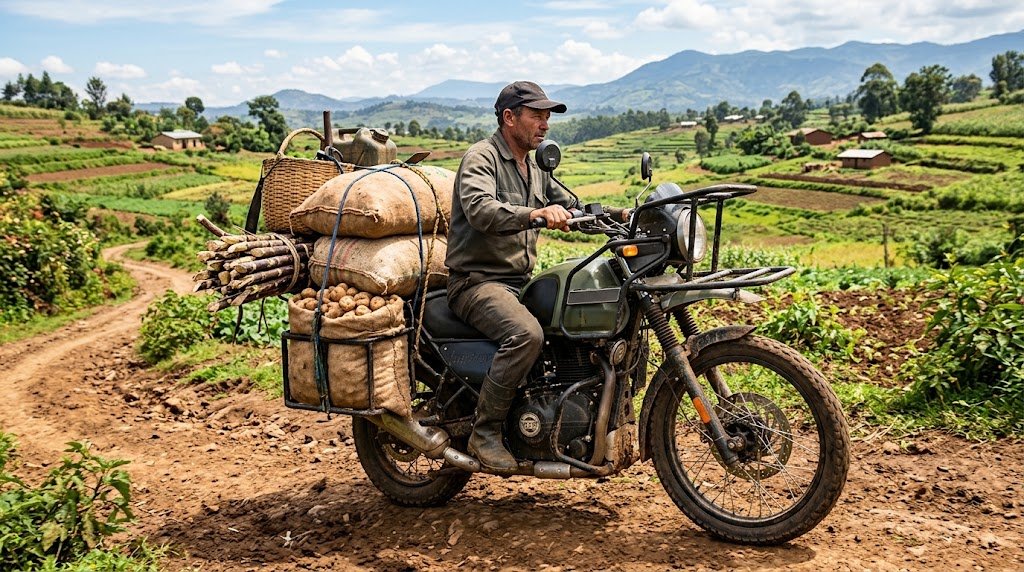
BUNDARAN AUTONET — When most people picture a motorcycle, their minds instantly race toward sleeks sportbikes tearing down highways or leather-clad cruisers rumbling past city stops. Yet, far away from polished asphalt and neon lights, a quiet revolution is unfolding on muddy paths and steep mountain trails. A different breed of two-wheeler is doing the heavy lifting, quite literally. Meet the high-torque utility bike—the unsung hero of modern rural life.
Unlike their speed-obsessed cousins, utility motorcycles aren’t built to break velocity records or turn heads at urban stoplights. Instead, they are engineered to pull, haul, and conquer terrain that would make a standard pickup truck think twice. Armed with short gear ratios and massive low-end grunt, these machines act as the backbone for farmers, rural couriers, and remote communities across the globe.
Imagine trying to navigate a narrow, waterlogged trail through a coffee plantation while balancing three sacks of fresh harvest. A standard commuter motorcycle would stall out, spun in place, or burn its clutch within minutes. This is precisely where low-speed, high-torque engineering shines, turning daunting agrarian logistical nightmares into smooth, manageable daily routines.
To understand why these bikes are taking over, one must look closely at their mechanical heart and frame structure. These motorcycles feature specially tuned engines designed to reach peak torque at low engine speeds. That means instant pulling power without needing to rev the engine to its absolute limits, preserving fuel and preventing excessive motor wear over time.
Beyond their muscular powertrains, their frames are built like industrial steel scaffolding rather than delicate origami. Reinforced rear subframes, dual rear shock absorbers, and heavy-duty cargo racks come standard straight from the factory. Many models feature foldable side platforms, allowing riders to securely strap down milk crates, tools, or live produce with total ease.
In vast agricultural zones from Southeast Asia to Sub-Saharan Africa, these two-wheeled powerhouses are fast replacing traditional pack animals and gas-guzzling trucks. They offer a rare combination of absurdly low operating costs and incredible mobility through dense foliage. Where a four-wheel-drive vehicle gets trapped by narrow suspension bridges, a utility bike slips right through without breaking a sweat.
Consider the daily routine of a dairy farmer in a remote mountain village. Every morning, hundreds of liters of fresh milk must reach processing centers before the heat spoils the yield. High-torque utility bikes equipped with customized side-coolers allow farmers to transport heavy liquid payloads across rocky terrain in half the time it used to take.
The utility bike ecosystem is also undergoing a massive technological shift thanks to rapid advancements in electric powertrains. Electric utility motorcycles are proving to be match made in heaven for heavy hauling applications. Electric motors deliver instant max torque from zero RPM, eliminating the need for complex clutch work when starting on steep, muddy inclines.
Furthermore, solar-powered charging stations are springing up in off-grid farming communities, allowing owners to charge their workhorses using free energy from the sun. This eliminates the need to ride dozens of miles just to purchase expensive fossil fuel in plastic jugs. It creates a self-sustaining cycle where clean energy directly powers local agricultural supply chains.
Maintainability remains another core pillar of the utility bike philosophy. Designers intentionally avoid overly complicated electronics or fragile plastic fairings that shatter during minor spills. Most mechanical components are exposed and easily accessible, meaning a farmer with basic hand tools and standard spare parts can perform routine maintenance right in the field.
The tires fitted on these machines also deserve special mention. Deep-knobby treads, puncture-resistant sidewalls, and reinforced rims ensure the bike maintains traction over loose gravel, deep mud, and wet riverbeds. Some specialized farm variants even feature dual-chain setups or all-wheel-drive mechanisms to climb slopes that would challenge an mountain goat.
Governments and international rural development agencies are increasingly recognizing the economic ripple effects of these humble vehicles. By providing cheap, reliable transport, smallholder farmers gain direct access to larger regional markets, eliminating predatory middlemen who cut into their profits. A single utility motorcycle can effectively lift an entire agricultural household out of subsistence living.
Beyond agriculture, these rugged machines serve as vital lifelines for emergency medical transport in remote geography. Fitted with specialized sidecar stretchers, medical utility bikes carry patients and vaccines across regions where roads exist only as maps lines. They bring life-saving healthcare infrastructure directly to doors that traditional ambulances simply cannot reach.
As global supply chains place greater emphasis on efficiency and sustainability, the demand for purpose-built cargo bikes will only climb higher. Manufacturers are continuously refining frame geometries, battery densities, and smart load-monitoring systems to make these vehicles even safer and more capable for everyday operators.
The world is finally waking up to the fact that power isn’t just about top speeds and flashy aesthetic designs. True power lies in the ability to carry the heavy loads of real life over the roughest terrain imaginable. High-torque utility bikes have proven that sometimes, the slowest, toughest machine on the trail is the one leading the way into the future.